

Ole Miss Has Declared Its Plan for Sam Leavitt: Make Him Win From the Pocket

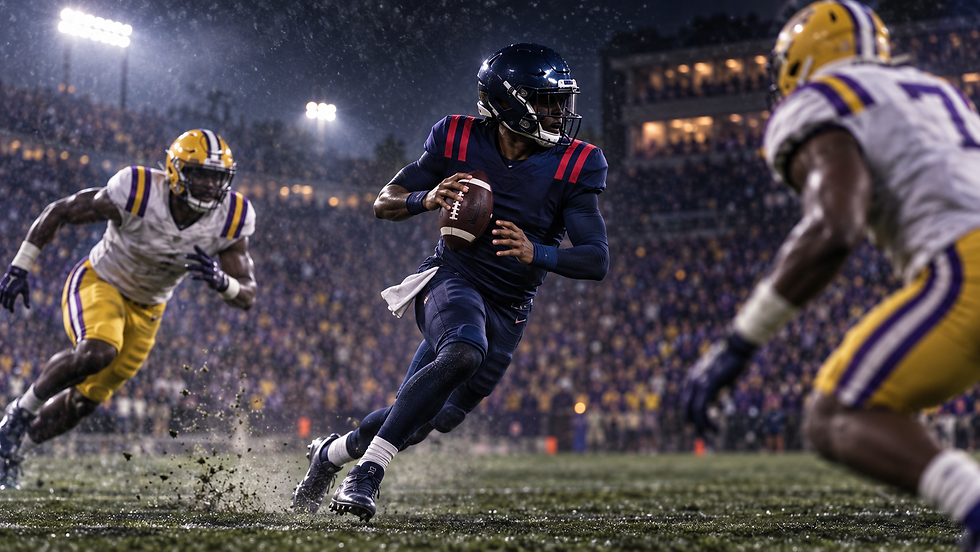
Ole Miss has made its central defensive idea public: keep Sam Leavitt from turning broken pockets into explosive runs and force LSU’s quarterback to operate as a traditional pocket passer. The logic is obvious. Leavitt has 135 rushing yards and five rushing touchdowns through two games. But it is not a free solution. He also has 574 passing yards, and Ole Miss is allowing 243 passing yards per game. The Rebels must compress the pocket without surrendering the space behind their pressure.
Pete Golding said the quiet part out loud
Ole Miss coach Pete Golding did not hide the objective when he previewed Saturday night’s Top-10 Magnolia Bowl. After praising Leavitt’s arm strength, athleticism and ability to extend plays, Golding said, “It’s going to be really important to try to make him become a pocket passer.”
That sentence identifies the game inside the game. Ole Miss does not merely want sacks. It wants a controlled rush that keeps Leavitt directly behind the LSU offensive line, takes away escape lanes and makes him solve coverage from a shrinking platform. For a quarterback whose legs have already changed both LSU games, containment matters as much as pressure.
Why Ole Miss wants Leavitt contained
Leavitt’s official rushing line against Louisiana Tech was 11 carries for 22 net yards, but that number hides how dangerous he remained near the goal line. He scored three rushing touchdowns, including a 17-yard run. Five sacks cost LSU 28 yards, which college statistics charge against the quarterback’s rushing total.
A week earlier against Clemson, Leavitt ran for 113 yards and two touchdowns. Through two games, the LSU quarterback has produced five rushing scores. When the first read disappears or protection breaks down, he can turn a defensive win into a first down before the coverage has time to react.
Golding’s preferred answer will likely be rush-lane discipline: defensive ends staying above the quarterback, interior defenders pushing the pocket without opening a seam, and second-level defenders keeping their eyes on Leavitt when LSU spreads the field. The objective is to make every scramble run sideways before it runs forward.
The vulnerability Ole Miss will attack
The pocket-passer challenge also targets the largest blemish on LSU’s young season. Leavitt has thrown four interceptions through two games, including three against Louisiana Tech. One became a 100-yard pick-six after LSU drove to the Bulldogs’ goal line.
Ole Miss will try to make the quarterback hold the ball long enough for coverage rotations to matter. Expect the Rebels to show pressure before the snap, drop defenders into passing lanes and force Leavitt to distinguish real rushers from simulated ones. If LSU falls behind the chains because of penalties or negative plays, Golding can become more aggressive with those disguises.
That is why LSU’s turnover issue cannot be separated from its protection plan. A clean pocket is helpful, but a clearly defined answer is more important. Leavitt needs to know where the football goes when Ole Miss overloads one side, when a safety rotates late or when the defense takes away the first concept.
Why the plan can backfire
Turning Leavitt into a pocket passer sounds simple until the defense considers what he has already done through the air. He has 574 passing yards in two games, including 344 against Louisiana Tech. In that win, Trey’Dez Green topped 100 receiving yards, Eugene Wilson III added 93 and Jackson Harris produced 80. LSU has multiple targets capable of punishing isolated coverage.
Ole Miss has not yet shown that it can squeeze the field without giving up production. Through two games, the Rebels are allowing 395.5 total yards and 243 passing yards per game. They have recorded four sacks, while opposing quarterbacks have completed 38 of 57 attempts for 486 yards, two touchdowns and one interception.
If the Rebels devote an extra defender to Leavitt’s legs, LSU can attack the vacated space with quick throws, option routes and running-back checkdowns. If the edge defenders play too cautiously, Leavitt gets extra time to reach intermediate routes. If they rush too far upfield, the escape lane returns. Containment is a balancing act, not a switch.
Three answers LSU must have
1. Protection calls that defeat simulated pressure
LSU must communicate cleanly when Ole Miss crowds the line of scrimmage. The offensive line and backs need to identify the most dangerous rushers, while Leavitt must be willing to replace a blitzer with the football. The best response to pressure is often a six-yard completion delivered on time.
2. A quick game that stays on schedule
Slants, hitches, running-back outlets and tight-end access throws can stop Golding from living in exotic third-down packages. LSU’s 10 penalties for 101 yards against Louisiana Tech repeatedly made the offense harder to manage. Staying out of obvious passing situations is part of protecting the quarterback.
3. Controlled movement instead of emergency movement
LSU should not remove Leavitt’s athletic advantage just because Ole Miss wants to contain it. Designed boots, half-rolls, read-option keeps and selective quarterback draws can move the launch point on LSU’s terms. The goal is to make Ole Miss defend his legs without asking him to improvise on every important snap.
The matchup inside the matchup
Ole Miss wants Leavitt static. LSU wants him decisive. Those are not the same thing. The Tigers can win from the pocket if Leavitt’s reads are clean, the protection communicates and the ball comes out before coverage disguises mature. They can also use controlled quarterback movement to punish defenders who become too focused on keeping him inside.
The danger is chaos. LSU survived four turnovers against Louisiana Tech; a Top-10 opponent on the road is less likely to forgive them. Leavitt does not need to prove he can win every snap with his arm. He needs to show Ole Miss that taking away one part of his game does not create predictable football.
LSU vs. Ole Miss game details
No. 7 LSU visits No. 8 Ole Miss on Saturday, September 19, 2026. Kickoff is scheduled for 6:30 p.m. CT at Vaught-Hemingway Stadium in Oxford, with ABC carrying the game. It is LSU’s SEC opener and Lane Kiffin’s first trip back to Ole Miss as the Tigers’ head coach.
Frequently asked questions
What is Ole Miss’s plan for Sam Leavitt?
Pete Golding wants the Rebels to contain Leavitt’s scrambling ability and force him to operate primarily from the pocket. That requires disciplined rush lanes, disguised coverages and pressure that does not create easy escape paths.
How many rushing touchdowns does Sam Leavitt have in 2026?
Leavitt has five rushing touchdowns through LSU’s first two games: two against Clemson and three against Louisiana Tech.
When is LSU vs. Ole Miss?
LSU and Ole Miss play Saturday, September 19, 2026, at 6:30 p.m. CT in Oxford. The game will air nationally on ABC.
Keep reading
Sources
Oxford wants Leavitt trapped in the phone booth. LSU must prove he can own the pocket without surrendering the weapon that makes him dangerous. Create an earthquake.

Comments