

Saturday Night in Death Valley: Why Tiger Stadium Is More Than a Stadium

Updated: 14 hours ago
Quick answer
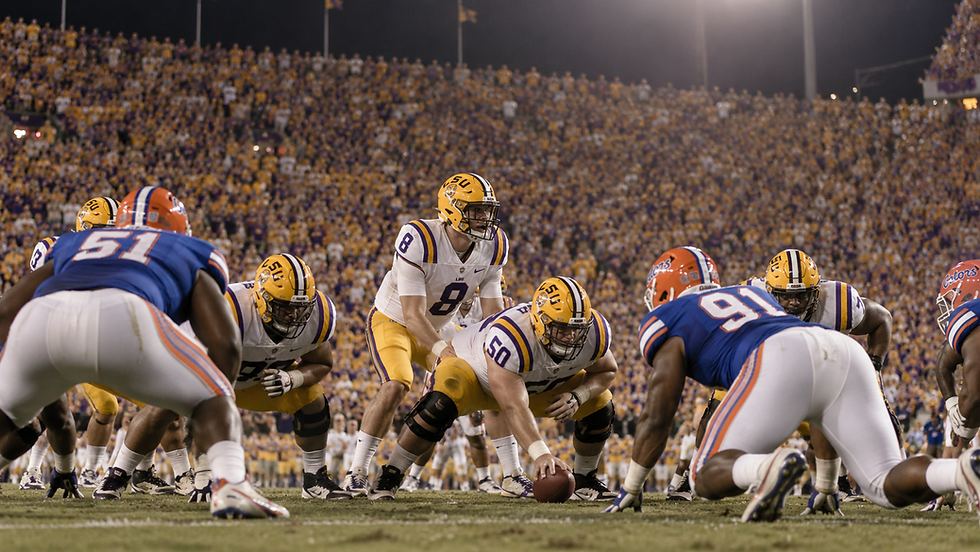
Tiger Stadium, also known as Death Valley, is LSU football’s 102,321-seat home in Baton Rouge and one of college football’s defining environments. Its identity comes from Saturday night games, Victory Hill, the Golden Band from Tigerland, Mike the Tiger, generational rituals and famous moments that LSU fans pass down like family stories.
There are football stadiums, and then there is Tiger Stadium on a Saturday night.
For people who did not grow up in Louisiana, that can sound like exaggeration. It is not. LSU football is stitched into family calendars, childhood memories, friendships, marriages, tailgates, road trips and the stories people tell long after the people in those stories are gone. Tiger Stadium is where those memories collect.
That is why calling it a stadium almost feels inadequate. It is a meeting place for generations. A cathedral made of concrete. A place where grandparents bring grandchildren and point toward a section of seats while telling them about Billy Cannon, Tommy Hodson, Jacob Hester, Joe Burrow or some game that happened before the child was born but somehow already belongs to them.

At LSU, the great games do not disappear when the clock reaches zero. They become family stories.
A stadium that grew with Louisiana
Tiger Stadium opened in 1924 with roughly 12,000 seats along the east and west sidelines. It kept growing because LSU football kept becoming something larger. The capacity reached 22,000 in 1931, 46,000 in 1936, 67,720 when the south end was closed in 1953, and eventually 102,321 after the 2014 south end zone expansion.
Even the building itself has LSU lore buried inside it. Tiger Stadium once contained dormitory rooms for students, and LSU football players temporarily lived in the stadium in 1986 while their athletics dormitory was being renovated. Few college football venues can say people literally lived inside the place that would become one of the sport's great temples.
Its first game came against Tulane on November 27, 1924. Its first night game followed in 1931. Over the decades, night football became less a scheduling detail and more an LSU identity.
Saturday night starts long before kickoff
The experience begins hours before anyone runs through a tunnel. Baton Rouge changes on a home Saturday. Parking lots become neighborhoods. Families unfold tables and chairs in places they have occupied for years. Pots come out. Music starts. Old friends find each other. Children throw footballs between tents while adults retell the same stories they have told a hundred times—and everyone still wants to hear them.
Then the day begins to narrow toward one place. Fans move toward Victory Hill. The team walks down. Mike the Tiger makes his appearance. The Golden Band from Tigerland follows. Thousands of people who spent the afternoon scattered across campus suddenly become one crowd moving toward the same destination.
That sequence remains part of LSU's official gameday rhythm. Victory Hill, Mike, the band, the pregame performance, the alma mater, the national anthem and the entrance of the Tigers are not background entertainment. They are the liturgy of LSU football.
The Golden Band from Tigerland and the sound of home
Every fan base has songs. LSU has sounds that can transport someone across decades in seconds. The Golden Band from Tigerland marching toward Tiger Stadium is one of them. The opening notes of a familiar tune can turn grown adults into the same people they were when they first heard it as children.
Fight for LSU after a score. Tiger Rag and the roar of T-I-G-E-R-S. The pregame show. The first notes of Callin' Baton Rouge spilling through the stadium before kickoff. None of those moments requires explanation to an LSU fan. The response is instinctive.
LSU itself describes Callin' Baton Rouge as a home-game tradition that brings tens of thousands of fans to their feet before kickoff. That is the part statistics cannot fully capture: a hundred thousand people recognizing the same cue and reacting together because they all know what comes next.
Mike the Tiger is not a mascot in the ordinary sense
There is also Mike. To call him simply LSU's mascot misses what the live tiger tradition means to generations of fans. Children grow up visiting Mike's habitat. Families take pictures there. Each Mike becomes part of a particular era of LSU life, connecting the football program to something older than any coach or roster.
Coaches leave. Players graduate. Conferences change. Uniform combinations change. Mike remains. The band remains. Tiger Stadium remains. Those constants are part of why LSU fandom feels inherited rather than acquired.
Why they call it Death Valley—and Deaf Valley
Tiger Stadium has carried the Death Valley nickname for generations, while LSU fans have also embraced Deaf Valley as a description of the noise. The reputation is not merely branding. Visiting teams have spent decades trying to communicate inside a bowl designed to hold sound and filled with people who believe making noise is part of their responsibility.
Quarterbacks turn to hand signals. Linemen watch the football instead of relying on cadence. False starts become crowd trophies. A third down at night can feel less like another football play and more like a demand from the entire building.
The night the legend registered on a seismograph
On October 8, 1988, LSU trailed No. 4 Auburn 6-0 late in Tiger Stadium. On fourth-and-10 from the Auburn 11, Tommy Hodson found Eddie Fuller for the touchdown that gave LSU a 7-6 victory.
The celebration was so violent that seismic equipment roughly 1,000 feet away on LSU's campus recorded it. The Earthquake Game became one of those rare moments where folklore and measurement collided. LSU fans had always said the stadium could shake. That night, it did.
Billy Cannon and the 89 yards Louisiana never forgot
Twenty-nine years before the Earthquake Game, another night became immortal. Halloween, 1959. No. 1 LSU. No. 3 Ole Miss. LSU trailing 3-0. Billy Cannon fielded a punt at the LSU 11-yard line and returned it 89 yards for the touchdown that helped give LSU a 7-3 win.
For decades, Louisiana parents told children about that run. Then in 2012, Odell Beckham Jr. fielded an Ole Miss punt at the same LSU 11-yard line in Tiger Stadium and returned it the same 89 yards for a touchdown. Fifty-three years apart, the same opponent, the same stadium, the same starting point, the same distance.
That is exactly how LSU history works. One generation hands a story to the next, and every so often the stadium seems to answer back.
Five fourth downs against Florida
In 2007, Florida came into Tiger Stadium and pushed LSU to the edge. The Tigers trailed 24-14 entering the fourth quarter. Then came one of the defining nights of the Les Miles era: LSU repeatedly put its season in the hands of fourth down and kept surviving.
The final drive lasted 15 plays and 8 minutes, 11 seconds. Jacob Hester kept moving LSU forward. The Tigers converted the critical fourth downs, and Hester scored the winning touchdown with 1:09 remaining. LSU won 28-24.
Years later, LSU fans do not remember that game as a neat series of statistics. They remember the feeling of Miles refusing to blink, Hester refusing to go down, and an entire stadium gradually realizing it was witnessing another story that would be told forever.
Tiger Stadium changes with every generation
The stadium is not frozen in 1959 or 1988. In 2012, LSU added the Victory Gold lighting tradition after wins. The 2014 expansion pushed capacity to 102,321. In 2024, new video boards, LED lighting and ribbon boards changed the visual experience again.
Newer traditions have joined older ones. Swag Surfin' can move through the crowd in a wave. Modern intro videos and light shows coexist with a band whose role predates almost everyone in the building. Tiger Stadium keeps absorbing each generation without surrendering the ones that came before it.
Why LSU fans take all of this so personally
Because for many LSU fans, these are not somebody else's sports memories. They are coordinates in their own lives.
Someone remembers watching Cannon because his father took him. Someone remembers the Earthquake Game because she was a student. Someone remembers 2007 Florida because it was the first game he attended with his son. Someone remembers 2019 because the entire family gathered in the same living room every Saturday and watched Joe Burrow turn an impossible season into reality.
Eventually the score becomes part of something bigger. People remember who was sitting beside them. Who called after the game. Who cooked. Where they parked. Which family member is no longer here to watch the next one.
Tiger Stadium matters because the stories inside it become attached to the people we love.
The real meaning of Saturday Night in Death Valley
LSU has won championships and produced Heisman winners, All-Americans, NFL stars and unforgettable teams. But the program's hold on Louisiana cannot be explained by trophies alone.
The power comes from continuity. The same colors. The same songs. The same hill. The same tiger. The same stadium. Different families and different decades walking through the gates carrying their own stories with them.
One day a child hears about Cannon's Halloween Run as if it happened yesterday. Later that child tells someone younger about the Earthquake Game, 2007 Florida, Burrow beating Alabama or another night that has not happened yet.
That is how a football game becomes folklore. That is how a stadium becomes sacred ground. And that is why Saturday night in Death Valley has never been just a game.
Tiger Stadium FAQ
When did Tiger Stadium open? Tiger Stadium opened in 1924. Its first game was played against Tulane on November 27, 1924.
What is Tiger Stadium's capacity? LSU lists Tiger Stadium at 102,321 seats following the south end zone expansion completed for the 2014 season.
Why is Tiger Stadium called Death Valley? Death Valley has been associated with Tiger Stadium since the 1950s and reflects the venue's reputation as one of college football's most intimidating environments.
What is Victory Hill? Victory Hill is the gameday route where LSU's team and the Golden Band from Tigerland make their pregame walk toward Tiger Stadium, surrounded by fans.
Did LSU's Earthquake Game really register on a seismograph? Yes. The celebration after LSU's late touchdown against Auburn in 1988 was recorded by seismic equipment on LSU's campus.
What are some of Tiger Stadium's most famous games? Billy Cannon's Halloween Run against Ole Miss in 1959, the 1988 Earthquake Game against Auburn and LSU's 2007 comeback against Florida are among the venue's defining stories, alongside many championship-era games.
Sources: LSU Athletics Tiger Stadium history and 100 Years of Tiger Stadium archives; official LSU gameday timelines and soundtrack/traditions pages; LSU football game archives.


Comments