

Born in the Heat, Forged After Dark: How Louisiana Created Saturday Night in Death Valley

Long before television executives discovered college football primetime, LSU found a better reason to play after dark: Louisiana itself. The heat, the humidity, the people and nearly a century of unforgettable moments turned a practical decision in 1931 into one of the most sacred traditions in sports.
There is a moment every LSU fan knows. The sun has been beating down on Baton Rouge all afternoon. The pavement is hot. The concrete around Tiger Stadium has spent hours soaking up Louisiana heat. Shirts have been surrendered to sweat. Ice chests are lighter than they were that morning. Somewhere beneath the oak trees, another pot of jambalaya is disappearing.
Quick Answer
Why did LSU begin playing football at night? In 1931, LSU installed lights at Tiger Stadium in part because Baton Rouge’s brutal early-season afternoon heat made daytime games uncomfortable, while evening kickoffs also worked better for refinery shift workers and helped LSU attract fans after other Louisiana games ended. LSU beat Spring Hill 35-0 in its first Tiger Stadium night game on October 3, 1931, and the experiment grew into one of college football’s defining traditions.
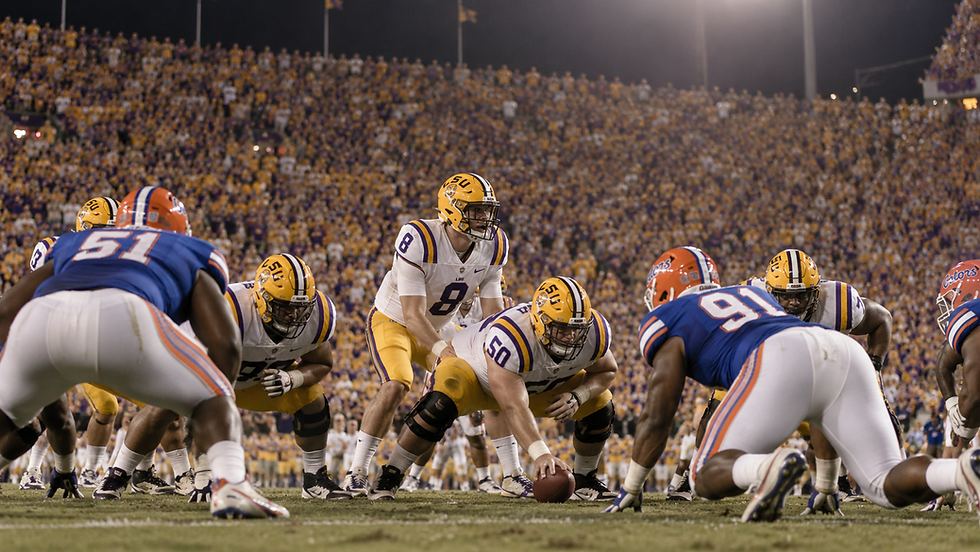
Then the shadows stretch across campus. The sky over Tiger Stadium turns from blue to orange, then purple. The stadium lights become visible. More than 100,000 people begin moving toward the same place.
This is when Tiger Stadium stops feeling like a building. This is when Death Valley wakes up.
And strangely enough, one of the greatest traditions in college football owes part of its existence to something Louisianans complain about nearly every summer day: the heat.
Before Death Valley, There Was Just Louisiana Heat
To understand why LSU football belongs at night, you have to understand September in Baton Rouge. National Weather Service 1991-2020 climate normals put Baton Rouge's average high at 90.5°F in June, 91.9°F in July, 92.2°F in August and still 88.7°F in September. The average September low is 68.9°F, meaning football season arrives before south Louisiana has truly cooled down.
Temperature is only half the punishment. Humidity changes the way the body experiences heat. The National Weather Service defines the heat index as the apparent temperature created when air temperature and relative humidity are combined. High humidity slows the evaporation of sweat, one of the body's main cooling mechanisms. In one NWS example, 96°F with 65 percent relative humidity produces a heat index of 121°F. Those values are calculated for shade; direct sunshine can make conditions feel as much as 15°F hotter.
Anyone who has crossed the LSU campus before an early-season afternoon kickoff already understands the science without needing the chart. The air does not just feel hot. It feels heavy.
In the early years of Tiger Stadium, there were no climate-controlled club seats waiting upstairs. There were concrete stands baking beneath the Louisiana sun. LSU eventually found a simple answer: turn on the lights.
1931: Skipper Heard Changes the Clock
Tiger Stadium opened in 1924. Seven years later, LSU graduate manager of athletics T.P. “Skipper” Heard made a decision that would help define the place for generations.
Heard understood that LSU had a problem larger than football strategy. Many Baton Rouge-area fans worked long days. Farmers needed daylight. Industrial and refinery workers had shifts that could interfere with afternoon football. Tulane was also a major football attraction in New Orleans and played Saturday afternoons. A later kickoff gave more people time to work, travel, tailgate and still reach Baton Rouge for the game.
Then there was Louisiana's September heat. LSU's own history of Heard's decision specifically points to scorching afternoon temperatures and concrete seats that became far more comfortable after sunset.
For roughly $7,500 during the Depression, Heard had lights installed in Tiger Stadium. On October 3, 1931, LSU played Spring Hill beneath them and won 35-0. Rain held the crowd to roughly 6,000 that night, so nobody could have known exactly what had just begun.
Saturday Night in Tiger Stadium had been born.
LSU Didn't Invent Night Football. It Did Something More Important.
LSU was not the first school ever to play football under artificial lights, and its own historical accounts make that clear. But LSU took night football and made it a central part of a major college program's identity.
That distinction matters. LSU did not simply experiment with a night game and move on. It built an entire Saturday around the evening kickoff. People could work in the morning. Families could drive to Baton Rouge. Fans could tailgate all afternoon. Then the sun went down and football began.
Long before networks turned Saturday night into a prized television window, LSU had already learned how powerful the night could be. LSU helped popularize the idea of “after dinner” football and turned Saturday night into a marquee college football experience decades before modern primetime became standard television programming.
In other words, television did not create Saturday Night in Death Valley. Television eventually discovered it.
Then the Nights Started Becoming Legends
A tradition survives because people repeat it. A legend survives because things happen that nobody forgets. Tiger Stadium got both.
1959: Billy Cannon Runs Through the Humidity
Halloween night. No. 1 LSU. No. 3 Ole Miss. At the 8 p.m. kickoff, the temperature was 73 degrees with 100 percent humidity. Fog hung beneath the brighter Tiger Stadium floodlights and gave the field an almost unreal appearance.
Ole Miss led 3-0 late. Then Billy Cannon fielded a punt at LSU's 11-yard line, broke tackle after tackle and ran 89 yards into college football history. LSU won 7-3 after a late goal-line stand. Cannon's Halloween Run became one of the most famous plays the sport has ever produced.
Think about the scene: 100 percent humidity, fog glowing beneath the floodlights, No. 1 against No. 3, and Billy Cannon running through Ole Miss defenders into Louisiana immortality. By then, the weather that helped push LSU into the night had become part of the theater.
1988: The Night LSU Literally Moved the Earth
On October 8, 1988, LSU trailed No. 4 Auburn 6-0 with less than two minutes remaining. Facing fourth-and-10, quarterback Tommy Hodson found Eddie Fuller in the end zone for the touchdown. Tiger Stadium erupted.
The reaction from 79,341 people was so intense that a seismograph operated by LSU's geology department roughly 1,000 feet away recorded the vibration. LSU won 7-6, and college football gained the Earthquake Game.
Plenty of stadiums claim to shake. LSU had a reading from the geology department.
1997: No. 1 Florida Walks Into the Wrong Place
Florida came to Baton Rouge on October 11, 1997 as the defending national champion and the No. 1 team in America. The Gators had won 25 consecutive SEC games. LSU had never beaten a No. 1-ranked team.
Then the lights came on. LSU won 28-21. Fans poured onto the field. Both goalposts came down. Years later, when LSU fans voted on the greatest night games in Tiger Stadium history, the 1997 Florida upset was their choice at the top.
There are generations of Tiger fans who can tell you exactly where they were that night. That is what traditions eventually become: not games, but markers in people's lives.
2007: Primetime Finally Understands
By 2007, television had fully embraced college football at night, and LSU gave a national audience the definitive Death Valley experience. No. 1 LSU hosted No. 9 Florida in national primetime on CBS before a then-record Tiger Stadium crowd of 92,910.
LSU repeatedly gambled on fourth down while climbing out of a 10-point fourth-quarter deficit. Jacob Hester finally powered into the end zone with 1:09 remaining. LSU 28, Florida 24.
This was exactly the kind of national primetime spectacle television wanted. LSU had simply been rehearsing for it since 1931.
2019: Burrow's Tigers Turn the Lights Into a Stage
In 2019, Joe Burrow, Ja'Marr Chase and Justin Jefferson brought another kind of electricity to Saturday night. No. 5 LSU hosted No. 7 Florida in front of a sold-out crowd of 102,321. The teams traded punches until Burrow found Chase for a 54-yard touchdown that helped seal a 42-28 LSU win.
Three months later, LSU was national champion. But some of the first real evidence that something extraordinary was happening came beneath the lights in Baton Rouge.
2022: One Play Against Alabama
In 2022, LSU and Alabama went to overtime. Alabama scored first. Jayden Daniels answered with a 25-yard touchdown run on LSU's first offensive play. LSU trailed 31-30.
Most teams kick the extra point. Brian Kelly went for two. Daniels rolled right and found freshman tight end Mason Taylor near the front-right pylon. Conversion good. LSU 32, Alabama 31. Students poured onto the field.
Another Saturday night had become family history.
2024: Ole Miss Learns the Same Lesson
During Tiger Stadium's 100th anniversary season, No. 9 Ole Miss controlled much of the night in Baton Rouge. LSU never led in regulation. Then came overtime. Garrett Nussmeier threw to Kyren Lacy on LSU's first offensive play, and Lacy caught the 25-yard touchdown that ended it. LSU 29, Ole Miss 26.
A crowd of 102,212 flooded the field while the Golden Band from Tigerland played into the Louisiana night. Different decade. Different players. Same place. Same darkness. Same insanity.
And It Is Still Happening
On September 26, 2026, No. 23 Texas A&M entered Tiger Stadium for another Saturday-night SEC game. LSU's defense smothered the Aggies, holding quarterback Marcel Reed to 106 passing yards and minus-13 rushing yards in a 35-6 Tiger victory.
Ninety-five years after Skipper Heard switched on those first lights, Saturday night in Baton Rouge still means something.
The Numbers Say the Night Really Is Different
The legend is not only emotional. LSU's own record book shows a measurable difference.
On LSU's official Tiger Stadium page, the published historical split since 1958 is 284-72-4 at night, a .794 winning percentage, compared with 50-28-3 during the day, a .636 winning percentage. LSU also lists a 112-15 record in Saturday night home games since 2000, an .882 winning percentage. Those published historical figures run through the 2024 season.
LSU's 2025 football media guide gives the broader all-time split through 2024: 358-112-13 in night games at Tiger Stadium, a .755 winning percentage.
Darkness is not magic. Opponent strength, scheduling patterns, television windows and different eras all affect those records. But the central fact survives every reasonable qualification: LSU has historically won more often in Tiger Stadium at night than during the day.
The legend has numbers behind it.
Why Tiger Fans Care So Much
This is the part outsiders sometimes misunderstand. LSU fans do not fight for night games because the stadium lights look prettier on television. They fight for them because Saturday night is part of the inheritance.
The tradition began in part because working Louisianans needed time to finish the day. Because farmers needed daylight. Because industrial workers needed their shifts to end. Because September afternoons were hot.
Then parents brought children. Those children grew up and brought theirs. Tailgating became an all-day ritual because there was somewhere everyone was going when the day ended. The Golden Band came down Victory Hill. The crowd filled the bowl. The sky darkened.
Eventually, generations of Louisiana families began associating the setting sun in autumn with LSU football.
That is why a daytime kickoff can feel wrong even when the game itself is enormous. It is not that LSU cannot play great football before sunset. It is that an entire culture was built around what happens after it.
The Most Louisiana Thing Possible
Maybe that is why Death Valley could only have become Death Valley here.
Louisiana took one of its most uncomfortable qualities and somehow transformed it into an advantage. The heat pushed football toward the evening. The evening gave fans more time to arrive. The extra hours deepened the tailgate. The darkness made the lights brighter. The lights made the crowd feel bigger. The crowd made the stadium louder.
And every once in a while, Billy Cannon broke seven tackles. Or Tommy Hodson hit Eddie Fuller. Or No. 1 Florida went down. Or Jacob Hester needed one more yard. Or Jayden Daniels decided one point was not enough.
Eventually, the solution to Louisiana's heat became something nobody wanted to give back.
There are bigger stadiums. There are newer stadiums. There are schools with their own traditions and unforgettable Saturdays. But there is only one place where the words “It's Saturday Night in Death Valley” can roll across the speakers and an entire state understands exactly what that means.
The heat did not make Tiger Stadium legendary. The humidity did not win football games. They simply helped push LSU into the darkness.
Louisiana did the rest.
And nearly a century later, when the sun disappears behind Tiger Stadium and those lights begin glowing against the Baton Rouge sky, college football is still watching something LSU figured out long before anybody called it primetime: Saturday night is when football becomes something more.
Sources and Further Reading
National Weather Service New Orleans/Baton Rouge — 1991-2020 climate normals: https://www.weather.gov/lix/newnormals
National Weather Service — Heat Index guidance: https://www.weather.gov/oax/heatsafety
LSU Athletics — Tiger Stadium history and night-game records: https://lsusports.net/facilities/tiger-stadium
LSU Athletics — Skipper Heard and the origin of night football at LSU: https://lsusports.net/news/2019/07/11/205174318-2
LSU Athletics — The Halloween Run: https://lsusports.net/news/2009/10/28/204822858
LSU Athletics — 1997 Florida upset: https://lsusports.net/news/2006/09/01/575747
LSU Athletics — 2007 Florida game: https://lsusports.net/news/2007/10/6/1258151
LSU Athletics — 2022 Alabama overtime win: https://lsusports.net/news/2022/11/5/lsu-tops-alabama-gutsy-ot-conversion-32-31
LSU Athletics — 2024 Ole Miss overtime win: https://lsusports.net/news/2024/10/12/tiger-stadium-comes-alive-in-thrilling-ot-win-over-ole-miss-29-26
LSU Athletics — 2026 Texas A&M win: https://lsusports.net/news/2026/09/26/football-dominates-no-23-texas-aandm-cruises-to-35-6-victory
Keep exploring Death Valley
See why the modern environment still matters in Why Tiger Stadium at Night Gives LSU an Edge.
Explore more classic moments in TigerHype’s LSU Football History coverage.
Follow the current Tigers through the 2026 LSU Football season hub.
Frequently Asked Questions
When was LSU’s first night game in Tiger Stadium?
LSU played its first night game in Tiger Stadium on October 3, 1931, beating Spring Hill 35-0.
Why did LSU start playing football at night?
LSU Athletics says several factors drove the experiment: refinery shift workers could attend evening games, LSU could attract fans after other Louisiana games ended, and September afternoon heat in Baton Rouge made night football more comfortable.
Who helped bring night football to LSU?
LSU credits T.P. “Skipper” Heard, then the program’s graduate-manager and later athletic director, with installing lights and pushing the 1931 night-football experiment.
Why is Saturday Night in Death Valley still important?
Night games became part of Tiger Stadium’s identity because generations of memorable LSU games, packed crowds and the stadium atmosphere reinforced the tradition long after the original practical reasons for playing after dark.


Comments