
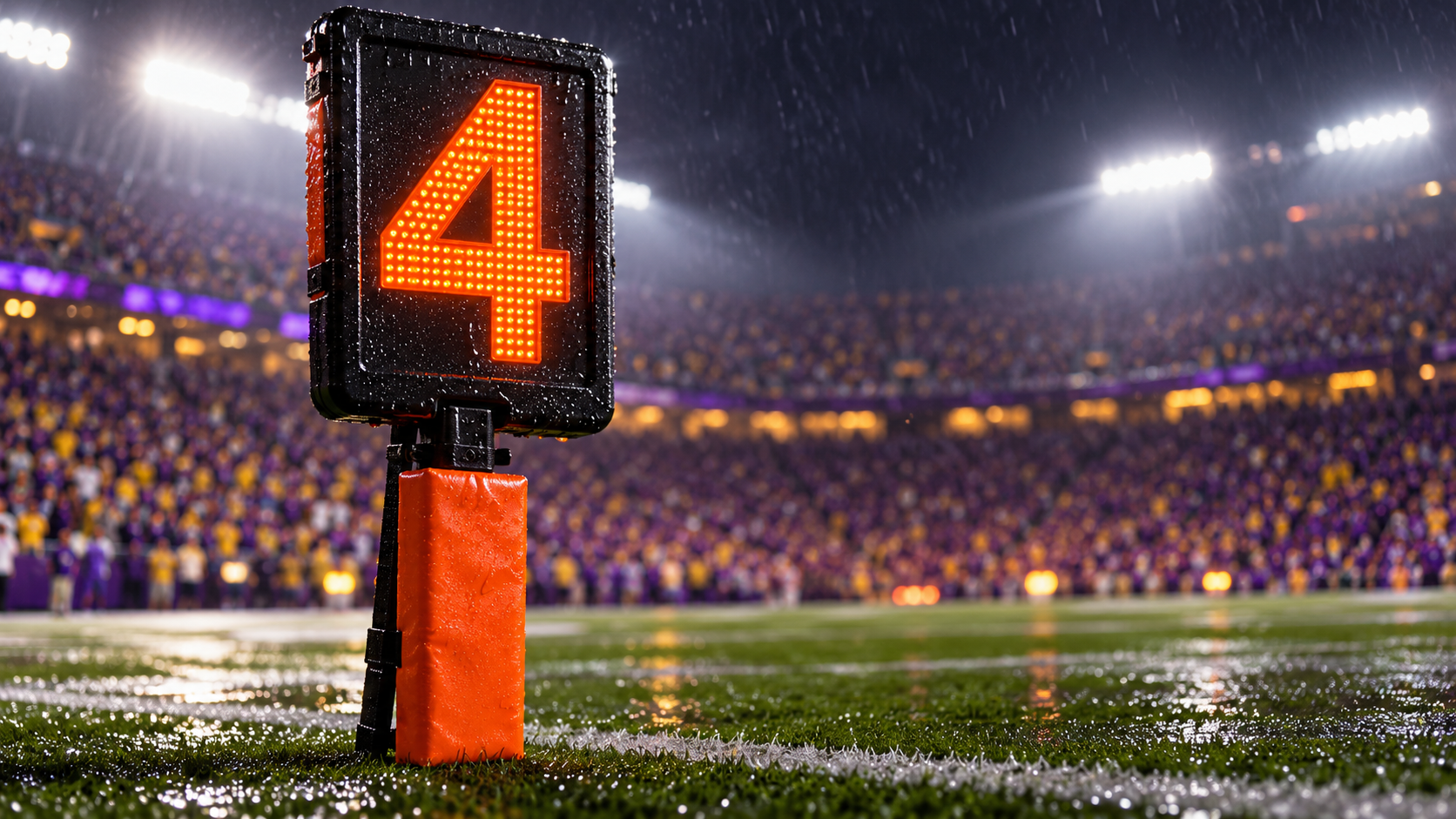
LSU’s 8-for-10 Fourth-Down Start Gives Kiffin a Road-Game Weapon

Lane Kiffin’s offense has already shown one trait that matters enormously on the road: LSU is willing to keep the ball in its own hands when fourth down becomes manageable.
Quick Answer
LSU Football has converted 8 of 10 fourth-down attempts through five games in 2026, an 80% success rate. LSU’s opponents are 1-for-4. The Tigers’ efficiency gives Lane Kiffin a valuable road-game lever before the October 10 trip to Kentucky: manageable fourth downs can extend drives, protect possession and reduce the number of chances the Wildcats receive.
What does LSU’s 8-for-10 fourth-down record show?
The sample is still small, but 8-for-10 is meaningful because fourth downs carry immediate consequences. A conversion extends the possession. A failure hands the opponent the ball at the spot. LSU has won that exchange often enough to treat fourth down as a real offensive option rather than an emergency.
The contrast is sharp on defense. Opponents have converted only one of four fourth downs against LSU. Across the two sides of the ball, the Tigers are plus-seven in successful fourth-down conversions.
Why Lane Kiffin can be aggressive
Fourth-down aggression works best when an offense consistently reaches manageable distances. LSU averages 6.6 yards per play, converts 52% of its third downs and has produced 141 first downs through five games.
Those numbers reduce the need for desperation calls. Kiffin can consider fourth down from a position of strength because LSU often needs one or two yards rather than six or seven. A quarterback run, a downhill carry or a quick perimeter concept can all remain available.
How LSU’s quarterback room changes the math
Sam Leavitt has rushed for 220 yards and six touchdowns, making the quarterback a genuine short-yardage threat. Defenses cannot sell out entirely on the running back when Leavitt can keep the ball, escape the edge or convert with a scramble.
Landen Clark has also produced four rushing touchdowns. That does not mean LSU will automatically change quarterbacks for fourth down, but it illustrates the room’s collective ability to create an extra gap in the running game.
Why fourth down matters at Kentucky
Road possessions are expensive. Crowd noise can create negative plays, and a home opponent can use one stop to build momentum. LSU’s 80% conversion rate gives the Tigers a way to answer that pressure without immediately surrendering the ball.
The key is field position. A fourth-down attempt near midfield carries a different risk than one deep in LSU territory. Kiffin’s most important decisions will not be whether to stay aggressive in general, but where the game, distance and defensive matchup justify that aggression.
What Kentucky must defend
Kentucky has to prepare for more than one fourth-down call. LSU’s 237.6 rushing yards per game can support a direct run, while the Tigers’ 310.2 passing yards per game prevent the Wildcats from crowding every short-yardage snap.
The most difficult scenario for Kentucky is fourth-and-short with Leavitt in the shotgun. The defense must account for the running back, the quarterback, a quick throw and a possible vertical shot if the secondary becomes too aggressive.
What LSU fans should watch
First, watch Kiffin’s decision line. Does LSU become aggressive once it crosses midfield, or only after reaching Kentucky territory? That boundary will reveal how much trust the staff places in its defense and punting options.
Second, watch the formation before the snap. Tight formations can create leverage for a run or play-action concept, while spread sets can force Kentucky to declare coverage and leave the box lighter.
Finally, separate good process from one result. An 8-for-10 start is excellent, but fourth-down decisions should be evaluated by distance, field position and matchup—not only whether a single play succeeds.
Sources and related LSU coverage
Primary source: LSU’s official 2026 cumulative statistics through October 4.
Continue with TigerHype’s third-down efficiency analysis, LSU–Kentucky kickoff and TV guide, 2026 LSU Football season hub and Sam Leavitt player page.
At Kentucky, where should Lane Kiffin’s fourth-down aggression line be: LSU territory, midfield or only after crossing the Wildcats’ 40?


Comments